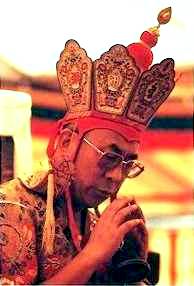
 A
special feature of the Kalachakra tantra is that the initiation is given to large
numbers of people, and can be attended by everyone who is interested. It should
be realized however that the people who do not take the commitments (like
taking refuge, bodhisattva vows and tantric vows) also do not receive the permission
to do the practices of the Kalachakra tantra.
A
special feature of the Kalachakra tantra is that the initiation is given to large
numbers of people, and can be attended by everyone who is interested. It should
be realized however that the people who do not take the commitments (like
taking refuge, bodhisattva vows and tantric vows) also do not receive the permission
to do the practices of the Kalachakra tantra.
As such, there is a large
difference between 'taking' the initiation and 'attending' it.
Shakyamuni
Buddha offered it for the entire country of Shambhala and one of the Shambhala
Kings gave the empowerment to a large group of inhabitants when they intended
to leave Shambhala.
His Holiness the Dalai Lama has commented that due to
instant communication and transportation of our time, our community includes the
entire planet and he has already given the initiation over 20 times, often to
crowds over 100,000 people. As the practice of all tantras can only be properly
done with the intention to benefit all sentient beings, statements like "Kalachakra
for World Peace" appear quite appropriate.
More information regarding the genereal commitments can be found at
the page Before the Initiation.
Extensive information on
the Kalachakra initiation can be found at Alex
Berzin's website.
The full initiation ritual of the Kalachakra
Tantra consists of 15 initiations, divided into three groups. The first seven
are "in the pattern of childhood", then there is a set of four High Initiations,
and a set of four Greatly High Initiations (referring to the symbolical passage
from being a lay Buddhist practitioner to a wandering ascetic, a monk and a Buddha
[9]). Actually, one could speak of 17 initiations: also an extra 'Preliminary
One' and a 'Final One' (the initiation of a 'Vajra Master Lord').
The initial
Preliminary initiation empowers one to visualize oneself as deity during the rest
of the ceremony; the first set of seven empowers one to do the generation stage
practices; the two sets of four (high and greatly high) empower one to do completion
stage practices; and the final Vajra Master Lord initiation empowers one to give
initiations to others (provided one fulfills the extensive requirements for a
tantric Master). Quite often in public initiations, only part of the full set
of initiations is given.
Some aspects of the first seven initiations
"in the pattern of childhood" are described in the table below.
INITIATION |
CORRESPONDS TO |
GIVEN BY |
PURIFIES |
RELATED TO |
|
|
|
|
|
| water* |
first
washing |
female
Tathagatas |
aggregates |
body |
| crown |
fixing
hair |
male
Tathagatas |
elements |
body |
| silk
ribbon* |
piercing
ears &
fixing adornments |
Shaktis |
10
winds |
speech |
| vajra
& bell |
laughing
& talking |
Kalachakra
& Vishvamata |
left
channel |
speech |
| conduct* |
enjoying
the senses |
Bodhisattvas |
6
sense powers & objects |
mind |
| name
giving |
giving
name |
wrathful
deities |
6
action faculties & actions |
mind |
| permission* |
teaching
reading & writing |
Vajrasattva
& Consort |
pristine
consciousness |
bliss
aggregate |
*: Initiations 1, 3, 5, and 7 consist also
of an extra "Internal Initiation": with each Internal Initiation, the students
are symbolically reborn in an ideal fashion. The Internal Initiations purify stages
of development in the womb. For example, the first Internal (water) Initiation
purifies the process of the initial development of the student's elements and
aggregates in the womb. These four Internal Initiations purify, or establish potencies
for purity, the respective development of the student's body, speech, mind and
bliss in the womb state.
The four higher initiations (which follow
above seven 'in the pattern of childhood') are interpreted in the Kalachakra "as
a symbolical passage from being a lay Buddhist practitioner to being a wandering
ascetic, a monk and a Buddha. .... Likewise, the receiving of of diadem and crown
during the four higher initiations is explained in terms of the Namasamgiti's
description of the Buddha as an ascetic with a crest of hair and a diadem."
[9]
 The
entire initiation ritual is actually much more extensive then the ritual normally
observed by the initiates; as summarized from [7] and [8]:
The
entire initiation ritual is actually much more extensive then the ritual normally
observed by the initiates; as summarized from [7] and [8]:
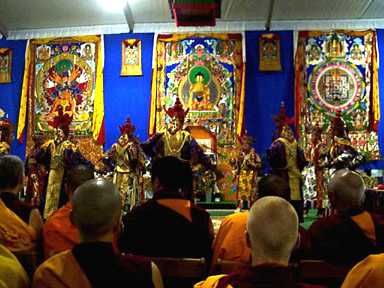
Site rituals
like: testing, requesting, purifying, taking possession, protecting and consecrating
(elaborate ritual dance, see the image on the right).
Preparation
rituals like: preparation of: the earth goddess, the five substances, the
chalk strings, the deities, marking the mandala.
On the third day, the hard
work of drawing the sand mandala begins, after daily elaborate prayers
and rituals. At its completion in 6 days, the Vajra Master blesses it again and
offering dances are carried out.
On the ninth day, the students firstly are
involved in the rituals of preparation, like taking the refuge and Bodhisattva
vows.
On the tenth and eleventh day, the actual initiation is given, consisting
of a complex succession of rituals.
On the twelfth day, initiates are welcomed
to see the mandala, after which the mandala is dismantled. The sand is
put into a vase and, with much ceremony, the vase is emptied in a local river,
lake or sea.
The last two stages involve the pacification of the mandala
site and the dedication of merit.
BIBLIOGRAPHY
[1]: Highest
Yoga Tantra, Daniel Cozort (Snowlion
1986)
[2]: The Kalachakra Tantra, Rite of
Initiation. Tenzin Gyatso the Dalai Lama and Jeffrey Hopkins (Wisdom, 1985)
[3]: Taking the Kalachakra Initiation,
Alexander Berzin, Snow
Lion, 1997
[4]: Transcending Time,
An Explanation of the Kalachakra Six-Session Guru Yoga, Gen Lamrimpa and B.
Allan Wallace (Wisdom 1999)
[5]: The Practice
of Kalachakra by Glen H. Mullin (Snow
Lion 1991)
[6]: Introduction to Kalachakra, commentary by Dr. Alex Berzin
June 28 - 30, 1985 at Institut Vajrayogini, France
[7]: Das
Mandala by Martin Brauen (Dumont 1992) (Later appeared in many languages.)
[8]: The Wheel of Time Sand Mandala,
by Barry Bryant (Harper Collins 1995)
[9]: The
Inner Kalacakratantra, A Buddhist Tantric View of the Individual, by Vesna
A. Wallace (Oxford University press, 2001)

