Kalachakra
initiations are unusual in the sense that everyone can attend them, unlike other
initiations which are only given to small groups of selected disciples. As long
as one tries to keep a positive mind state, it can be considered a blessing or
inspiration towards the future possibility of practicing in the Kalachakra tantric
tradition. If nothing else, it is likely to be a unique experience of an elaborate
spiritual ritual.
This rest of this page is mainly intended to give some basic information
for people who wish to seriously practice the Kalachakra tantra.
In order to practice, one needs to understand the basics of Buddhism
and commitment to it (taking refuge). Furthermore, one must be ready to take the
Bodhisattva Vows (part of Mahayana Buddhism), Tantric Vows and having received
the Kalachakra Initiation from a qualified Tantric Master. These subjects are
briefly explained below.
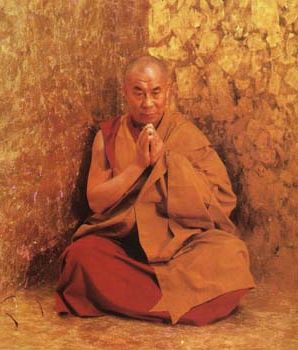
His Holiness the Dalai Lama (currently the most
prominent Kalachakra Master), often emphasizes the importance of these preliminaries,
for example during the Kalachakra initiation in Bloomington USA in 1999:
"I
would like to congratulate those who are attending here only for the preliminary
teachings and not the Kalachakra. Because in actual fact the topics I am covering
in the preliminary teachings are the more important elements of the practice.
So I would like to express my appreciation for those who are just attending the
preliminary teachings.
Those who do the opposite, not attend the preliminary
teachings but rather come just for the Kalachakra Empowerment Ceremony, I must
admit that these people are more clever than I am. When I announce a Kalachakra
Empowerment, because Kalachakra is so popular it attracts people, but what I really
intend is to spend time during the preliminary teachings and speak more about
the general aspects of the path of the Dharma. So these people have in fact managed
to fool me but of course if among those people who are just attending the Kalachakra
teaching if they have a firm grounding in the common paths, the general practices
of the Dharma then of course it is fine. But if people simply come for the empowerment
with no real grounding in the preliminary practices then simply attending the
Kalachakra ceremony alone, I do not know what benefit that can have."
 Or,
if possible even more direct, Holiness said the following during the Manjusri
Initiation in New York City in 1998:
Or,
if possible even more direct, Holiness said the following during the Manjusri
Initiation in New York City in 1998:
"If one can engage
on the Vajrayana path on the basis of a clear understanding of the tantric path,
then it can be truly profound and effective. Some Tibetan masters of the past
have emphasized many of the significancies of the Vajrayana teachings by the representation
of the vajra and bell. The Tibetans say that if one utilizes these implements
with a full awareness of their significance and a full understanding of the Vajrayana
path, then when one rings the bell it will have a profound symbolism and meaning.
But the simple act of playing a bell doesn't really have any profundity. One can
see that even cows have bells around their necks and make loud noises.
The
reason I point this out is that unfortunately sometimes people in their rush to
attain Vajrayana teachings because of the way in which it is promoted as the best,
highest and quickest, people hastily rush to receiving initiations without full
realization of what it involves and what is its true significance. There is a
real danger that one's ringing a bell is like the cow's. This is very true even
of the Tibetan Buddhists as well. When they hear there is an initiation everyone
rushes to it with great enthusiasm. But if someone hears there is a series of
lectures taking place on Buddhism then they say, "Oh yes, well….."
Sometimes I exploit this weakness and use it to my advantage. I announce there
is a Kalachakra initiation and everybody rushes to it. I do the Kalachakra ceremony
last and very fast but I spend much more time explaining the key elements and
a general overview of the Buddhist path. That way they have to sit and listen
to them. This is my skillful means! Although I thought I was rather smart but
some of the students are even smarter. They make sure they arrive only exactly
on the Kalachakra initiation day."
 BUDDHISM
IN A NUTSHELL
BUDDHISM
IN A NUTSHELL
Buddhism is a religious practice started by the historical
Buddha Shakyamuni some 2,500 years ago. It can be considered a philosophy and
even a type of psychology, but more than anything, it describes a practice to
eliminate suffering.
The basis of Buddhist teachings is condensed in the
Four Noble Truths:
1. In life, we are confronted with
suffering (dukkha in Sanskrit).
2. Suffering is caused by desire/craving and
the results of our actions (karma).
3. It is possible to end all suffering
and achieve enlightenment (nirvana/buddhahood).
4. At the basis of the practice lies the
Eight-fold Noble Path, which describes: correct thought/attitude, correct speech,
correct actions, correct livelihood, correct understanding, correct effort, correct
mindfulness, and correct concentration.
Furthermore, some very
important aspects of Buddhism to be understood are:
- Karma; the fact
that our actions have consequences.
- Rebirth; we are all reborn after
we die, until we end the 'cycle of death and rebirth' (samsara) by becoming enlightened.
- Renunciation;
wishing to be free from suffering and not being attached to the pleasures in the
cycle of death and rebirth.
- Meditation; in order to develop ourselves towards enlightenment,
we need to train our mind with meditation, so as to limit our negative habits
and develop positive qualities.
- Wisdom; conventional wisdom is about
taking the right decisions in this world. Ultimate wisdom is to realize that we do
not possess a permanent self or soul; rather, we are results of causes and conditions,
impermanent and we do not exists independently of the world around us.
As the Buddha
said to the villagers of Kalama:
"If it agrees with your
experience and reason, and when it is conducive to the good and gain of oneself
and all others, then one should accept the teachings, and live up to them."
WHAT
DOES IT MEAN TO BECOME A BUDDHIST?
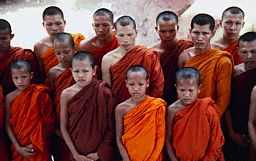 After
someone has decided that the Buddha, his teachings (Dharma) and the spiritual
community (Sangha) are worthwhile to practice with confidence, one can commit
oneself to Buddhism and its practices by 'Taking Refuge'. This is basically when one vows to respect and follow the guidelines
of the Buddha, the Dharma and the Sangha. It means that one chooses a direction
in life. The word Refuge refers to taking refuge from suffering, like we can take refuge in a shelter against bad weather.
After
someone has decided that the Buddha, his teachings (Dharma) and the spiritual
community (Sangha) are worthwhile to practice with confidence, one can commit
oneself to Buddhism and its practices by 'Taking Refuge'. This is basically when one vows to respect and follow the guidelines
of the Buddha, the Dharma and the Sangha. It means that one chooses a direction
in life. The word Refuge refers to taking refuge from suffering, like we can take refuge in a shelter against bad weather.
WHAT
IS MAHAYANA BUDDHISM?
There are various schools and lineages in Buddhism,
but a major distinction is made between the so-called Northern and Southern schools,
simply said; Theravada and Mahayana.
In brief, the Theravada school emphasizes
practice to achieve nirvana
as an Arhant, and to liberate oneself from the suffering cycle of rebirth.
In the Mahayana schools, the end-goal is to lead all living
(sentient) beings away from suffering; in order to do that, one strives to achieve
Buddhahood (the ultimately highest evolved state).
Although the philosophical
differences between these two schools are not very large, the difference in end-goal
(liberation of an Arhant or Buddhahood) creates significant differences in the
practice. The Mahayana schools put much emphasis on love and compassion in the
practices; and the ideal practitioner is a Bodhisattva; someone who is altruistically
intent on liberating all sentient beings.
In all schools, one can take refuge at the beginning of the path,
and one can choose ordination to become a novice or fully ordained
monk or nun. When one wishes to commit oneself to the Mahayana school,
one can also take the Aspiring
Bodhicitta Vows and also the actual Bodhisattva
Vows. These vows are independent of the monks' or nuns' ordination,
but - like all vows in Buddhism - need to be based on taking refuge first.
WHAT
IS BUDDHIST TANTRA?
 Tantra
is a special type of Buddhist practice, which can lead to rapid development of
a disciple towards Buddhahood, so it is a part of the Mahayana tradition. Buddhist
tantra was developed in India, but is currently mainly preserved in the Tibetan
schools of Buddhism.
Tantra
is a special type of Buddhist practice, which can lead to rapid development of
a disciple towards Buddhahood, so it is a part of the Mahayana tradition. Buddhist
tantra was developed in India, but is currently mainly preserved in the Tibetan
schools of Buddhism.
Tantra is a 'secret' practice; not because practitioners
wish to be special people with privileges, but because the practices require great
care, commitment and guidance by a qualified teacher. The techniques used are
quite powerful, and if not applied correctly can lead to serious harm for the
practitioner and others. Just like driving a car requires several precautions
like learning traffic rules and getting acquainted with the car before driving
can be reasonably safe, so does tantra require 'preliminaries' before practice
can be carried out safely.
The main preliminaries to tantric practice are:
1.
Taking Refuge in the Buddha,
Dharma (teachings) and Sangha (Buddhist community): becoming a Buddhist.
2. Renunciation:
a realization is best, but a proper understanding is essential.
3. Bodhicitta:
a realization is best, but a proper understanding is essential.
For most initiations, it is required to take the aspiring
Bodhisattva vows and/or the Bodhisattva
vows. The Kalachakra initiation requires both to be taken, latest during the initiation process itself.
4. Wisdom
of Emptiness: a direct realization is best, but a basic understanding
is important.
5. Faith/confidence:
solid confidence both in the teacher
and the teachings
is essential to avoid serious karmic problems when doubts arise.
6. Reliance
on a spiritual teacher: proper confidence in a teacher and verifying his/her
qualifications is essential.
7. Preliminary
Practices: depending on the teacher/disciple relationship, a teacher can
ask a disciple to carry out a series of specific practices, like recitation of
mantras, doing prostrations etc. to prepare yourself. If possible, it is always good to verify with a qualified tantric master if doing certain practices and taking specific initiations will be advantageous for you.
8. Empowerment or initiation: without
this ceremonial permission to practice by a qualified teacher, tantric practice
is inappropriate, and will not lead to any realisations.
9. Tantric vows: for the higher tantric classes, one needs
to take tantric vows. These vows are secret to the uninitiated, so students need
to take 'a leap of faith' and trust the teacher and the practice before taking
them. The Kalachakra tradition also has its own set of Tantric vows to be adhered
to.
Obviously, it is not easy to describe a whole religion in one page.
You could for example have a look at the web-site A
View of Buddhism for a more extensive introduction. For much more detailed information, see for example Alex
Berzin's website.
When you feel ready to actually take the initiation, do have a look at the page Taking the Initiation, with recommendations on how to prepare yourself properly.

