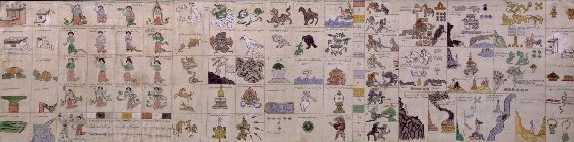
Kalachakra means Time-Wheel,
as "Kala" is Sanskrit for Time and "Cakra" (or Chakra) is Wheel in Sanskrit. One
could also translate it as Time-Cycles. Much in this tradition revolves around
the concept of time and cycles: from the cycles of the planets, to the cycles
of our breath and the practice of controlling the most subtle energies within
one's body on the path to enlightenment.
The time-cycles in the external universe are interrelated to the inner
cycles of energy in our bodies. Thus, the phrase 'as it is outside,
so it is within the body' can be found in the Kalachakra Tantra to emphasize
similarities between ourselves and the cosmos; the basis for astrology.
But the similarities are taken to an even more profound level of connections
and interdependence as taught in the Kalachakra literature. Ultimately,
the teachings are designed to guide the practitioner on the path to
Buddhahood, and the Kalachakra contains its own unique methods which
are among the most complicated within Buddhism. However, individual
practitioners require require different methods to achieve the same
goals.
Based on a mix of Indian, Chinese and Kalachakra Tantra sources, the
unique system of the Tibetan calendar and astrology
was developed. The system is used in a quite different way from the
western astrological approach, where birth-charts form the main basis.
It should be noted that the time of birth is generally considered much less important
in buddhist thought, for example because the actual new life started at the time
of fertilization of the egg, rather than at the moment of birth.
The Kalachakra astrological system forms one of the main building blocks
to compose the Tibetan calendar.
Part of the first chapter of the Kalachakra Tantra is dedicated to making
an accurate calendar. The astrology in the Kalachakra is not unlike
the Western system, and complicated calculations are required to determine
e.g. the exact location of the planets. The system is so complex, that
the traditional Tibetan calculations may require an overhaul, as Edward
Henning suggests in his book 'Kalacakra
and the Tibetan Calendar.
As with many of the concepts in Kalachakra, much of the basis for eg.
astronomy, astrology and time-divisions can be found in the traditional
teachings of the Indian Vedas, but the interpretation can be different
The Bon religion was well established in Tibet
before the introduction of Buddhism. Over the centuries however, it appears that
many Buddhist practices have taken root in Bon and reverse. For someone not too
familiar with robes, iconography or rituals it may even be hard to spot the difference.
Astrology
is important within the Bon system. Methods are given for divination, warding
off negative influences, astrological calculations and medical diagnosis.
The
four types of astrological calculation systems according to David Snellgrove are:
- The mirror of magical horoscopes
- The circle of Parkhas (trigrams)
and Mewas (magic squares in 9 colours) - Chinese origin
- The Wheel of Time
(Kalachakra) of the Elements
- The Jushak method: calculation of interdependence
A
very important Bon deity is called Balchen Geko, who is said to govern time and
the three world of existence. In this respect the deity is analogous to Kalachakra
in Buddhism.
The Tibetan system works with a 360-day lunar year and cycles
of 60 and 180 years. As a year is longer than 360 days, some days are doubled,
but others are skipped in a complicated manner. To make the calendar fit the observations,
occasionally even an extra month is introduced.
|
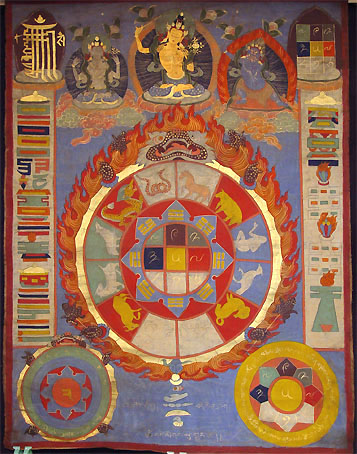
Move your mouse over the image to see an explanation.
The image above shows some aspects as discussed below: on the belly
of the Chinese Tortoise in the center are the nine Mewas, surrounded
by the 8 Trigrams, next are the twelve Animals. The 10-fold Powerful
Symbol of Kalachakra is on the top left, next to Chenrezig, Manjushri
and Vajrapani. |
CHINESE ORIGINS
From
Chinese astronomy and astrology originate concepts like the Trigrams from the
I Ching, the nine Magic Squares or Mewas, cycles of 12 and 60 years, the twelve
Animals, the five elements and the duality of Yin and Yang etc. The traditional
explanations say that princess Kongyo introduced Chinese astrology in Tibet in
643, but much earlier influences are very likely.
Two main Tibetan systems
are of Chinese origin: 'Naktsi' or 'black astrology' (referring to the Tibetan
name for China: 'black area'), and the 'astrology of the elements' or Jungtsi.
Five
Elements
The five Chinese elements or agents are Earth, Water, Fire, Wood and Metal; which are different from the elements that constitute the
universe in Indian astrology: Earth, Water, Fire, Air and Ether.
The Chinese elements are natural dynamic forces of transformation - energies -
and constantly interacting with each other. The names do not directly relate to
the objects of the same name, but refer to affinities which can lead to positive,
neutral and negative relations. Too much or too little of a specific element can
become dangerous. They are related to a direction and a time of year. Earth relates
to the periods around the end and start of each season and is related to the intermediate
directions (NE, SE, SW, NW). Wood dominates in spring and the East, Fire in summer
and the South, Metal in the autumn and the West, Water in the winter and the North.
Each element has a specific relation to an activity, colour, planet, organ etc.
The elements have specific relationships with each other, described as Mother,
Son, Friend and Enemy. They also can have a feminine or masculine polarity - similar
to Yin and Yang.
Twelve Animals
The twelve animals: Rat, Cow,Tiger,
Hare, Dragon, Snake, Horse, Sheep, Monkey, Bird, Dog and Pig relate to hours,
days, months and years. Each animal is related to an element which represents
its life force, a direction, a specific sex and certain personality treats. The
animals can go together well or difficult in various levels.
Each year is
a combination of an animal and an element. This leads to cycles of 12 x 5 = 60
years. Also, years are alternatingly male or female.
Nine Mewas
The
'nine moles' or 'nine coloured islands' are derived from the I Ching and Chinese
numerology. Each of the nine Mewas is related to a colour, a direction and an
element. For example, the three whites (1, 6 and 8) are metal. Each day, month
and year, the Mewas move.
Eight Trigrams (Parkhas)
These represent
the equivalent of the Chinese pa-kua, which form the basis of the I Ching. In
turn, the pa-kua are based on the concept of Yin and Yang. They are: Fire, Earth,
Metal, Sky, Water, Mountain, Wood and Wind. They are an extension of the theory
of the Five Elements.
INDIAN ORIGINS
Tibetan
astrology may have been influenced by Indian sources as much as from Chinese.
Analogous to above, India was known as the 'white area' and gave rise to the term
'white astrology'.
Early Indian civilisation had much cultural interchange
with the outside world, which is reflected in an identical zodiac to the Mesopotamians
(twelve signs and twelve houses) and the widespread decans. Later on however,
differences occurred for example when most other systems moved away from the early
sidereal zodiac, which is preserved in the Indian tradition. Far back in history,
also the Chinese and Indian system may have common origins. Similarities are for
example the 28 Chinese lunar constellations and the 27 or 28 Indian Naksatras
(from the Vedas), and the importance of the lunar nodes, Rahu and Ketu.
Signs
of the zodiac
The Indian system is based on the observation of the sun,
moon and the planets like Western astrology. The sky at night appears like a globe
dotted with stars surrounding the earth. During one year, the sun moves along
this expanse of stars and completes one cycle. This cycle is divided in 12 sections,
called the signs of the zodiac. Western astrology follows the cycles of the sun
related to the seasons, and the Tibeto-Indian system follows the cycles of the
sun related to the stars, and there is a small difference between these two. Over
the centuries, a difference of almost a complete sign has accumulated. For the
rest, the signs are the same as in the Western system: Aries, Taurus, Gemini,
Cancer, Leo, Virgo, Libra, Scorpio, Sagittarius, Capricorn, Aquarius and Pisces.
The general explanation of the signs is similar to the Western system. Two major
differences are the relation to different parts of the body and the fact that
Indian signs are divided into day and night signs (indicating when their influence
is strongest).
Lunar mansions
Indian astrology mentions 27 lunar
mansions (Naksatras), but as one of them comprises two adjacent constellations,
it covers 28 constellations. Each of these mansions is related to an Indian element
(Wind, Fire, Water, Earth). In the Tibetan system, the lunar mansions have also
been connected to the Chinese elements and directions.
 Planets
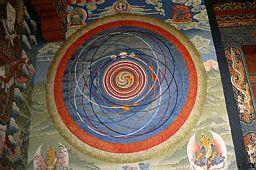
Both the signs of the zodiac and the lunar mansions are ruled by a particular
planet, in order: Ketu, Venus, Sun, Moon, Mars, Rahu, Jupiter, Saturn, Mercury.
(Ketu and Rahu are nodes of the moon.) The ruling of the planets over the signs
is the same as in Western astrology.
KALACHAKRA
The
Kalachakra tantric system contains not only an extensive religious practice system,
but also medical knowledge. At the core of the system is the very familiar concept
of 'as above, so below', the correspondence of the outer universe with the inner
physical and mental processes in humans. It describes the interaction of human
and cosmic phenomena with time and builds a complete system of Indian astrology.
Interestingly enough, this tradition contains all elements of Indian astrology,
but merges it with Chinese principles. The Tibetans started to adopt the 60 year
cycle in 1027, as it was taught both in the Kalachakra tantra and the Chinese
tradition.
About Kalachakra astrology and astronomy, the website Kalacakra.org is probably the best source of information on the web.
BUDDHISM
One
could say that almost everything in Tibetan culture is strongly influenced by
Buddhism. Even myths have been 'buddhified' over the ages. In Tibet, usually a
teacher (lama), either monk or layman, would be the local astrologer. When living
in a monastery, he would be responsible for establishing the calendar for religious
practices and festivals.
The following legend comes from 'Tibetan Astrology'
by Philippe Cornu. It is based on the manifestation of a Buddha called Manjushri
(see image), who is a personification of wisdom and insight. Tibetan teachers
invoke Manjushri at the commencement of any astrological undertaking.
"At the beginning of the present age or kalpa, while the future universe
was still immense chaos, Manjushri caused a giant golden turtle to arise from
his own mind, and this turtle emerged from the waters of the primordial ocean.
Seeing in a dream that the universe in formation required a stable base, Manjushri
pierced the flank of the turtle with a golden arrow. The injured animal turned
on its back and sank into the ocean, giving forth blood and excrement, from which
there arose the constituent elements of the universe. The created world thenceforth
rested on the flat belly of the turtle, upon which Manjushri wrote all the secrets
of the times to come in the form of sacred hieroglyphic signs."
As
Tibetan astrology is so directly related to religion, it is regarded as a practical
method to reduce uncertainty and suffering. The correct motivation of an astrologer
is compassion (wanting others to be free from suffering), and as such an astrologer
is not different from a spiritual practitioner, a medical doctor or a Buddhist
teacher.
Unlike the modern Western calendar, the Tibetan calendar is based on the cycles of
the moon, and various dates are considered especially auspicious
or inauspicious for certain practices. The information to collate
this page is mainly taken from the sources mentioned at the bottom
of this page.
Also some of the most important days of the Theravada
tradition are included: over the centuries, a difference of one
month has developed with the Tibetan tradition. Edward Henning describes the probable origin of this discrepancy in his book 'Kalacakra and the Tibetan Calendar'.
The complicated Tibetan calendar is based on
lunar cycles. As the lunar cycle is less than 30 days, and the year
is divided into 12 months, tricks are applied to compensate for
the difference between the 12 moon cycles in approximately 354 days
and the actual 365-something days of the year. For this, sometimes
dates appear double or not at all. About every 30 months, like in
early 2000, even a complete month was doubled for compensation.
Special days which fall on double days are usually
celebrated on the second day, but may be celebrated on the first
day if it is more convenient. Special days which fall on missing
days are usually celebrated on the preceding day.
There are four major
Special
Buddha days

or "Festivals" (düchen) in a year which relate to the
life of Buddha Shakyamuni. During these days, it is said that the
effects of positive or negative actions are multiplied 100 million
times, so practice is strongly advised.
Chotrul Düchen: During the first two weeks
of the new year, it is celebrated that the Buddha displayed a miracle
each day to increase the merit and devotion of future disciples.
During these days, the Gelugpa Mönlam Chenmo (great prayer festival)
is celebrated and extra practice is highly advised. The 15th of
the 1st month is the "Day of Miracles".
Saga Dawa Düchen: the 15th of the 4th
month, Buddha Shakyamuni's Birth, Enlightenment and Parinirvana are celebrated. He was born in Lumbini (current-day Nepal) became
enlightened in Bodhgaya (India) and entered parinirvana ("passed
away") in Kushinagar (India).
Chökhor Düchen: the 4th of the 6th month,
the "First Turning of the Wheel of Dharma" (first
teaching) is celebrated. For the first seven weeks after his Enlightenment,
Buddha did not teach. Encouraged by Indra and Brahma, he then gave
his first teachings at Sarnath on the Four Noble Truths.
Lha Bab Düchen: the 22nd of the 9th month,
'Buddha Shakyamuni's Descent from the Heaven of 33' is celebrated.
Buddha's mother had been reborn in Indra's heaven. To repay her
kindness and to benefit the gods, Buddha spent three months teaching
in the Heaven of 33. This is not as often stated, in Tushita
heaven; Tushita is the realm where the Buddha lived before he
descended to Earth. Possibly somewhat confusing can be that one
week before, on the 15th of the 9th month, it is celebrated that
he accepted to return from the Heaven of 33.
In the Theravada tradition the following
main full-moon days are observed (information from Urban
Dharma):
Magha Puja (‘Sangha Day’)
The Buddha gave the teaching on the basis of the discipline
(Ovada Patimokkha) to the spontaneous gathering of 1250
arahants.
Vesakha Puja (Wesak) (‘Buddha Day’)
The birth, enlightenment and passing away of the Buddha.
Asalha Puja (‘Dhamma Day’)
The Buddha’s first discourse, given to the five
samanas in the Deer Park at Sarnath, near Varanasi. The
traditional Rainy-Season Retreat (Vassa) begins on the
next day.
Pavarana Day
This marks the end of the three-month Vassa-retreat. In
the following month, lay people may offer the Kathina-robe
as part of a general alms-giving ceremony. |
During a (partial) solar eclipse the effects
of positive and negative actions are multiplied by 10,000 according
to the
Khandro site, 100 million
times according to Lama Zopa Rinpoche. During (partial) lunar eclipse,
the factor is 7 million according to Lama Zopa Rinpoche, practices
like taking the Eight Mahayana Precepts are thus strongly advised.
Every months, certain dates on the lunar calendar
have special significance. On the Buddha-daysare said to be multiplied. The significance and advised practices on these days may vary, but here are some examples:
- Tibetan 8th: special day for Medicine Buddha, Tara and/or Mahakala practice and taking Eight
Mahayana Precepts
- Tibetan 10th:
Guru Rinpoche day: on the 10th of each month,
a special occasion in Guru Padmasambhava's life is celebrated. Tsog ritual
is advised on this day by everyone who has received a Highest
Yoga Tantra initiation, it is specifically related to the "Father
tantras"
- Tibetan 15th, full moon: Amitabha Buddha, meditation, recitation
of Sutras and taking Eight Mahayana Precepts, Kalachakra day
- Tibetan 25th: Dakini's day: the 25th of every month
is related to the "Mother tantras" and tsog is advised for everyone who has received a Highest Yoga Tantra initiation.
- Tibetan 29th:
Dharmapala's day (Dharma Protectors):
the 29th of every month is a special day for Protector practice.
- Tibetan 30th, new moon: Shakyamuni Buddha meditation, recitation
of Sutras and taking Eight Mahayana Precepts
Sojong: on 14 or 15th and 29th or 30th,
confession practice for monks and nuns.
Saka Dawa: the 4th month; 100,000 multiplying
of positive actions, so practice is emphasized and eating meat or
other 'black food' (like any meat, fish, eggs, onions, garlic etc.)
is discouraged.
The 11th month is especially associated
with the practices of Chakrasamvara and Vajrayogini, which belong
to the Mother Tantras. The 25th of this month is an annual special
days for these practices.
OTHER ANNUALLY OCCURRING DAYS
TIBETAN
MONTH |
DAY |
OCCASION |
| 1 |
1st |
Tibetan New Year - Losar; see
here for a short description |
| 1 |
14th |
Anniversary of Milarepa. |
| 1 |
21st |
Anniversary of Jamyang Khyentse Wangpo, great master of
the 19th century. |
| 3 |
1st |
Kalachakra New Year |
| 3 |
15th |
Buddha Shakyamuni taught the Kalachakra tantra |
| 3 |
25th |
Anniversary of the great 5th Dalai Lama. |
| 4 |
15 |
Shakyamuni's birthday, enlightenment and parinirvana. |
| 4 |
23rd |
Anniversary of Virapa, founder of the Sakya school. |
| 6 |
15th |
Local deity day - also Shakyamuni's birthday according
to the Theravadin school. |
| 6 |
10th |
Anniversary of Guru Rinpoche (Padmasambhava). |
| 7 |
15th |
Discovery of the 4 medical tantras, special Medicine
Buddha day. |
| 9 |
3rd |
Anniversary of Jigme Lingpa, one of the great Nyingma
masters. |
| 9 |
4th |
Anniversary of Karma Paksi, second Karmapa. |
| 10 |
25th |
Anniversary of Tsongkhapa, founder of the Gelugpa school. |
| 11 |
3rd |
Anniversary of Dusum Khyenpa, first Karmapa. |
| 11 |
6th /7th |
Nine Bad Omens-day 'Ngenpa
Gu Dzom'; advised to not start actions on this day (like
retreat, journey or new job).
[Alex Berzin:] this starts 12 hrs after dawn on the 6th and lasts 24 hours
until approx. 5pm on Tibetan 7th |
| 11 |
7th/8th |
Ten Auspicous Omens, 'Zangpo
Chu Dzom', occuring together, the day after the Nine
Bad Omens
[Alex Berzin:] after Nine Bad Omens;
it starts approx. 5pm on the 7th until approx. 5pm on
Tibetan 8th |
| 11 |
26th |
Anniversary of Jamgon Kongtrul the Great, eminent master
of the 10th century. |
| 11 |
29th |
Offering day to Dharma protectors (Gutor). |
| 11 |
30th |
House cleaning day. |
Generally, Monday is a good day to hang prayer
flags and Friday is very good. According to Lama Zopa Rinpoche,
by hanging prayer flags (including long prayer flags and banners)
on the wrong astrological dates, "you will continuously receive
obstacles."
The following are inauspicious dates according to the Tibetan
calendar: 10th and 22nd of the First, Fifth and Ninth months; 7th
and 19th of the Second, Sixth and Tenth months; 4th and 16th of
the Third, Seventh and Eleventh months; 1st and 13th of the Fourth,
Eighth and Twelfth months.
This can be very confusing to non-Tibetans. When a baby is born,
one calls it one year old. This is probably connected to the fact
that the baby started its rebirth already 9 months earlier at
conception. Next, birthdays for ordinary people are normally celebrated
once a year, as part of Losar (Tibetan New Year). This means in
practice that a baby born on the last day of the Tibetan year
is called one year old, and can be called a two-year-old on the
next day! So if you need to know accurately how old a Tibetan
is, try to find out when he or she was born according to the Western
calendar.
The birthdays of great Tibetan saints are usually celebrated on
the same date of the Tibetan calendar. Probably to avoid confusion
(but also adding to it), the birthday of His Holiness the Dalai
Lama is celebrated on a fixed date of the Western calendar: July
6.
Book references:
Kalacakra and the Tibetan Calendar by Edward Henning, 2007, ISBN-978-0-9753734-9-1 (cloth)
Tibetan Astrology by Philippe
Cornu, Shambala 1997, ISBN: 1-57062-217-5
Encyclopedia
of Tibetan Symbols and Motifs by Robert Beer, Serindia, ISBN 0-906026-48-2
Tibetan Astronomy and Astrology, Tibetan
Medical and Astro Institute Dharmsala, 1995.
Tibetan
Astro-Science, by Jhampa Kalsang, astrology paintings by Buchung
Tsering, Tibetdomani, Rome,
2001.
Rigpa calendar


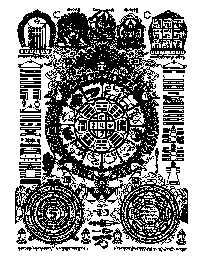 In
a Tibetan village, the astrologer would use his skills to advise people
about nearly everything: from the weather, the best time to harvest,
verify if and when two people should marry, to important business deals.
In case the outcome would be negative, often religious practices would
be advised to remove obstacles, which would be carried out by monks
of the local monastery. Traditionally, a doctor in Tibetan medicine
(Amchi) has also studied Astrology to determine for example the best
timing for a treatment. As a consequence, in many villages, the Tibetan
doctor would also be the astrologer; besides a local Buddhist teacher,
he/she would probably be the most important person to visit for general
advice.
In
a Tibetan village, the astrologer would use his skills to advise people
about nearly everything: from the weather, the best time to harvest,
verify if and when two people should marry, to important business deals.
In case the outcome would be negative, often religious practices would
be advised to remove obstacles, which would be carried out by monks
of the local monastery. Traditionally, a doctor in Tibetan medicine
(Amchi) has also studied Astrology to determine for example the best
timing for a treatment. As a consequence, in many villages, the Tibetan
doctor would also be the astrologer; besides a local Buddhist teacher,
he/she would probably be the most important person to visit for general
advice.