Kalachakra in Context
THE INDUS VALLEY CIVILIZATION
People
of the Indus Valley Civilization (also called Harrapan Civilization after the
major city of Harrapa) were mainly farmers. Eminent scholars have concluded that
the origins of the practices of yoga and meditation can be traced to the Indus
Valley civilization. An image of a human figure has been found that is seated
in a cross-legged posture, hands resting on the knees and eyes narrowed - clearly
suggesting meditation. Also, the wandering ascetic is frequently mentioned. These
ascetics are said to have practiced methods of mind training, to have been celibate,
naked or clothed in the most meager of garments, to have had no fixed abode, and
to have taught a way beyond birth and death.
THE
ARYANS According to most scholars, the original Indus Valley civilization.
was abruptly interrupted sometime between 1800 and 1500 BCE by an invasion of
the Aryans (people from a region somewhere in Eastern Europe). Needless to say
these were warriors and traders, as opposed to the original population of farmers.
After the middle of the second millennium BCE, Indian society was largely dominated
by Aryan values. Many of the Aryan principles still dominate "orthodox Indian
philosophy" and present-day Hinduism; such as the importance of the Vedic scriptures
and the supremacy of the Brahmic class (origins of the caste-system). A simplistic
overview of the contrast between the Indus Valley and Aryan culture is given in
below table. Characteristic Indus Valley Aryan Religious practice Meditation
sacrifice (to the gods) Main practitioner Ascetic Priest Purpose of life liberation
this life, then heaven Focus in life renunciation householder rebirth/future existence
importance of this life Morals karma social values "gods" merely different "world"
to be worshiped social position Equality Caste Origin of Wisdom own experience/meditation
scriptures like Vedas.
SCHOOLS
OF THOUGHT CONTEMPORARY TO THE BUDDHA From about 1500
to 600 BC much interaction of above opposed traditions occurred. The religious
and philosophical world at the time of the Buddha With the risk of oversimplifying
things, one could say that Jainism and Buddhism are mainly further developments
of the principles of the Indian Valley Culture, whereas the "orthodox schools
of Indian (Hindu) philosophy" were leaning more to the Aryan culture.
EARLY
HINDUISM Three basic principles rule the orthodox schools
of Hinduism:
1. Belief in an eternal, infinite, all-embracing neuter principle
of ultimate reality called Brahman. The pervasive force lying within all beings,
Brahman is conceived as the "self," or atman, of all forms of life.
2. Supremacy
of the sacred texts like the Vedas (probably composed about 1500-1200 BC)and Upanishads
(c. 400 BC).
3. Supremacy of the Brahman (priestly) class as the highest
representative of religious purity and knowledge, and many support the notion
that social and religious duties are differently determined according to birth
and inherent ability. Various schools of Hinduism were developing during
the time of the Buddha, like Mimamsa, Vedanta and Samkhya (see below).
Theistic
Hinduism replaced the Vedic sacrificial cult with a form of worship or service
to an image or representation of the deity called puja and an attitude of respectful,
but often enthusiastic, devotion called bhakti. Puja consists of a more or less
elaborate ritual in which the deity is invoked into an image that is established
in either the home or temple, is honored as a royal guest with a seat, offerings
of water, garments, perfumes, flowers, food, and so on, and is then dismissed
out of the idol he has temporarily deigned to inhabit. The main purpose of the
ritual is the communion with the deity gradually leading to a more permanent and
even closer relationship between the worshiper and God.
The main deities
worshipped in Hinduism are: Vishnu, Shiva and Shakti. Many of the other deities
within the Hindu pantheon are worshipped on occasion, either on specific dates
or depending on the need of the practitioner. Most schools of Hinduism (still)
emphasize aspects inherited from the Aryan tradition like; caste, the authority
of scriptures like the Vedas, and the practice of sacrifice . However, important
elements of the culture of the Indus Valley civilization., such as renunciation,
meditation, rebirth, karma, and liberation have also been absorbed.
The practice
of yoga is known to be quite old, and may also have its roots in the pre-Aryan
culture.
SAMKHYA
As the Samkhya school is of importance for the Kalachakra Tantra, some more
on this early Hindu school of thought by Sanderson
Beck [3]: 'Kapila, the legendary founder of the Samkhya school,
is said to have been an incarnation of Vishnu or Agni; he probably lived during
the seventh century BC at the time of the early Upanishads. The word samkhya means
discriminating knowledge and came to mean number as an exact form of knowledge.
In Asvaghosha's Life of the Buddha (Buddhacarita), Siddartha is taught Samkhya
ideas during his ascetic phase. Aradha described nature (prakriti) as consisting
of the five subtle elements, the ego, intellect, the unmanifest, the external
objects of the five senses, the five senses, the hands, feet, voice, anus, generative
organ, and the mind. All of these make up the field which is to be known by the
soul. Worldly existence is caused by ignorance, the merits and demerits of former
actions, and desire. He then explained the problems of mistakes, egoism, confusion,
fluctuation (thinking that mind and actions are the same as the "I"), indiscrimination
(between the illumined and the unwise), false means (rituals and sacrifices),
inordinate attachment, and gravitation (possessiveness). The wise must learn to
distinguish the manifested from the unmanifested. When the prince asked how this
is to be accomplished, Aradha explained the practice of yoga.
Though an orthodox
Hindu school, Samkhya did criticize the killing of animals in the sacrifices.
The intellect (buddhi) controlled by the spirit (purusha) evolves the mind (manas),
the senses, and then the gross elements. The three qualities found in all beings
are goodness (sattva), passion (rajas), and darkness (tamas). Goodness brings
pleasure, passion pain, and darkness apathy. The knower of the field is emphasized
as the spirit (purusha) or soul (atman). Samkhya and yoga are considered two aspects
(knowledge and practice) of the same philosophy. The standard 25 Samkhya principles
are enumerated as the eight material principles and the sixteen modifications
completed by the all-important spirit (purusha) or unmanifest knower of the field.
The elaborated Samkhya doctrine is attributed to Pancashikha, but the earliest
Samkhya text is the Samkhya Karika from the second or third century CE by Ishvara
Krishna.' JAINISM
Mahavira (Great Hero) lived around 570-490 BC and was a contemporary of the
Buddha. He is considered the main prophet (Tirthankara) who founded Jainism in
this era. Similar to Buddhism, Jainism teaches that their principles have been
taught in the past by enlightened teachers, and will be taught again in the future.
The main principles of Jainism could be summarized as: - Ahimsa
or nonviolence, a consequence of the belief in Karma
- Anekantvad,or multiple
views points
- Apirigraham, or avoidance of material possessions
- Satya,
or the renunciation of secular life. There are many similarities
between Jain and Buddhist philosophy, like a belief in karma, detachment, meditation
and relativity (realization that there is always more than one viewpoint). Also
less obvious aspects appear similar, for example the similarity of the cosmology
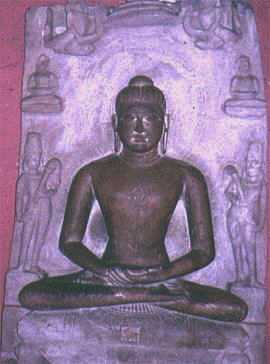
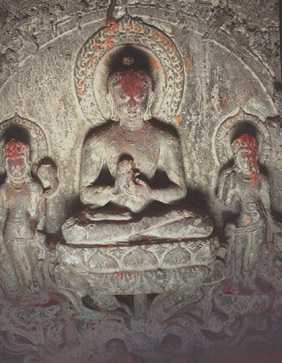
in the Kalachakra Tantra). Often, it is not easy for the lay person to distinguish
between an ancient depiction of the Mahavira and the Buddha, as they are both
usually depicted in a similar meditation posture, like below left the image of
the Mahavira and at the right the Buddha. The most obvious difference is the fact
that the Jain saints are naked as they practice fairly extreme asceticism and
renunciation of possessions.
To illustrate the Jain concept of relativity of different
viewpoints, they use the parable of 5 blind men trying to experience an elephant
by means of touch: A group of five blind men came upon an
elephant. The first man, feeling the enormous leg, said, "This thing is very much
like a tree." The second, standing near its ear, reached up and said, "This is
a winnowing fan!" "No, " said a third as he grasped the moving trunk. "Be careful.
This creature is a serpent." "I disagree," said a voice at the other end. "It
is only a frayed piece of rope". The last man commented, "You are all wrong. I
have felt this thing on both sides and it is just a wall."
Jainism
teaches, that once the person has applied the three principles of detachment,
karma and relativity, he or she can experience and share Maitri which is pure
love, understanding and compassion for all beings (an extremely important aspect
of Mahayana Buddhism). Moreover, as described at the jainmuni
webpage of 2001: "In the Buddhist scripture Majjima Nikaya, Buddha
himself tells us about his ascetic life and its ordinances which are in conformity
with the Jain monk's code of conduct. He says, "Thus far, SariPutta did I go in
my penance. I went without clothes. I licked my food from my hands. I took no
food that was brought or meant especially for me. I accepted no invitation to
a meal." Mrs. Rhys Davis has observed that Buddha found his two teachers Alara
and Uddaka at Vaisali and started his religious life as a Jaina."
OTHER
PHILOSOPHIES Besides these well-known religions, other
- and often quite radical - philosophies were known at the time of the Buddha,
although not existing anymore at present, like:
- Naturalists like followers
of Purana Kashyapa, who denied both virtue and vice, and thus all moral efficacy
of human deeds (Karma).
- Determinist Ajivika (in the strict sense followers
of Makkhali Gosala - contemporary and early friend of Mahavira) who denied sin
and freedom of will, and rebirths are destined without influence of human behaviour.
- Materialists, Lokayata or Carvaka (after one of the great teachers of this
school) like Ajita Keshakambalin, who, besides denying virtue, vice, and afterlife,
resolved man's being into material elements. They posed that this world extends
only to the limits of possible sense experience and denied the authority of the
scriptures. Brhaspati was probably the founder of this school, which could be
called hedonistic.
- Skeptics like Sanjaya Belathiputta, who, in reply to
the question "Is there an afterlife?" would not say "It is so" or "It is otherwise,"
nor would he say "It is not so" or "It is not not so."
BUDDHISM
A PROTEST OR AN OFFSHOOT TO HINDUISM? Few scholars would
disagree that at the time of the Buddha, a very heterogeneous and actively developing
religious culture flourished in India. This generally accepted historical reality
proves that Buddhism was neither a protest against, or an offshoot of Hinduism
(this view is even expressed for example in the Ecyclopedia Brittanica). Buddhism
simply proved to be one of the more successful new schools of thought within a
large variety of philosophies.
As debate is a very old traditional means
of testing (spiritual) teachers in Indian culture, of course one can trace many
philosophical works (especially in the Mahayana tradition), that could be interpreted
as protesting against, or arguing with other traditions. Western philosophers
may have misinterpreted these works as "protest", as such a thing is
unthinkable within Western religious systems. The Buddha himself actually refused
to argue on spiritual matters, he explained that he only presented what he had
realized as the truth. On the other hand, Buddhism arose from an existing culture,
and inevitably many elements of other contemporary traditions are found in Buddhism.
In the same sense one could argue that Christianity would be an offshoot of (or
protest to) Judaism and Islam is an offshoot of (or protest to) Christianity... It
appears that Buddhism draws most of its inspiration from the religious culture
of the Indus Valley civilization.; like the elements of renunciation, meditation,
rebirth, karma, and liberation. Also, many symbols of the Indus Valley civilization.
have religious significance and are also sacred to Buddhism. They include the
pipal tree (later known as the bodhi tree, or ficus religiosa), and animals such
as the elephant and deer. On the other hand, aspects similar to the Aryan tradition
can be clearly traced, especially in the rituals of tantric Buddhism. This in
contrast to Hinduism, where many of the Aryan principles dominate, but also contains
various elements of the Indus Valley Culture.
BUDDHA AS REINCARNATION OF VISHNU? Vishnu
is a Hindu god thought to incarnate in various forms called Avatars. One of them
is the hero-king Rama who battled the demon Ravana with the aid of Hanuman, the
monkey-headed hero, another avatar is Krishna who is depicted as a blue flute-player
and a lover of many women each of whom feels she is the only one. Since the Buddha
is considered by many Hindus (not by Buddhists!) to be one of these Avatars, Hinduism
and Buddhism will probably always remain quite interlinked. Main
sources for this page:
[1] Fundamentals of Buddhism by Peter
Della Santina
[2] Encyclopedia
Brittanica
[3] Ethics of Civilization Vol.2 India & South East Asia by Sanderson Beck
|

